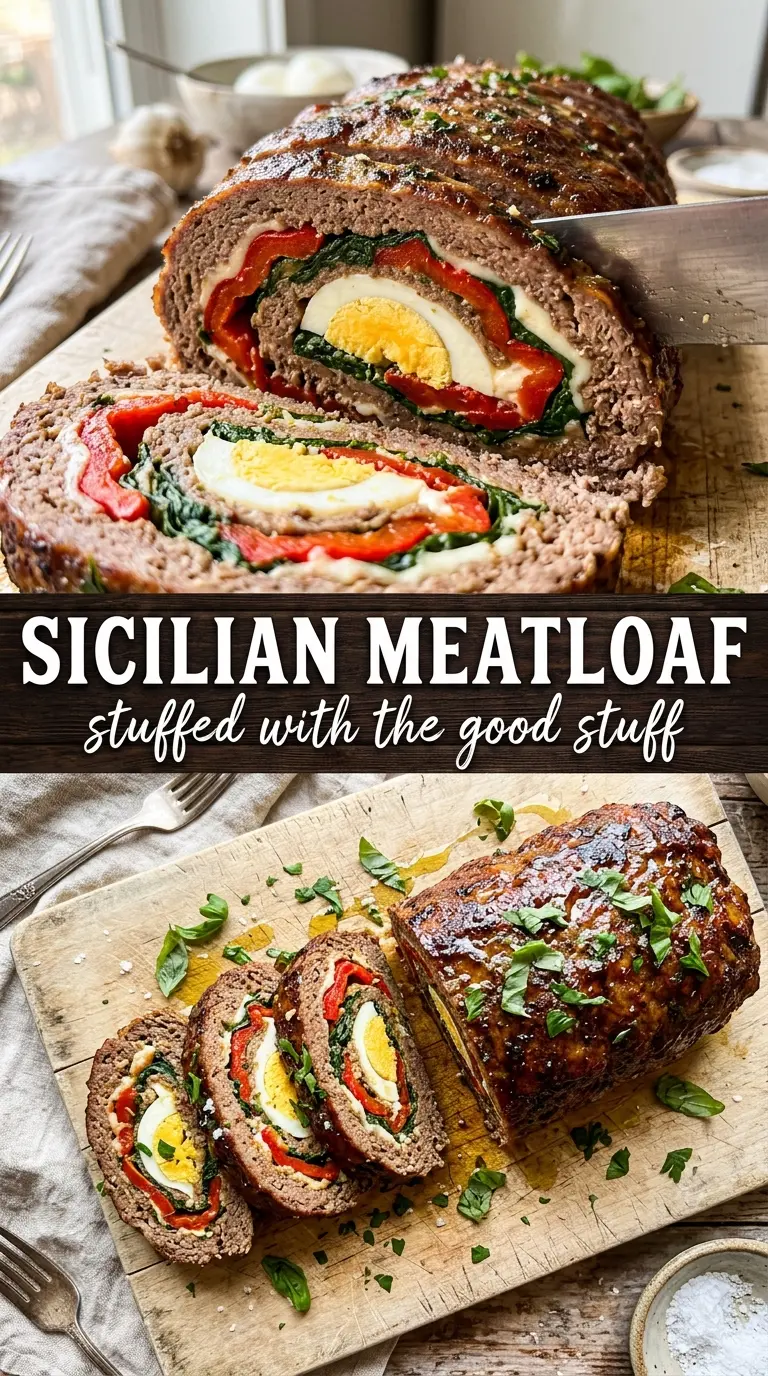
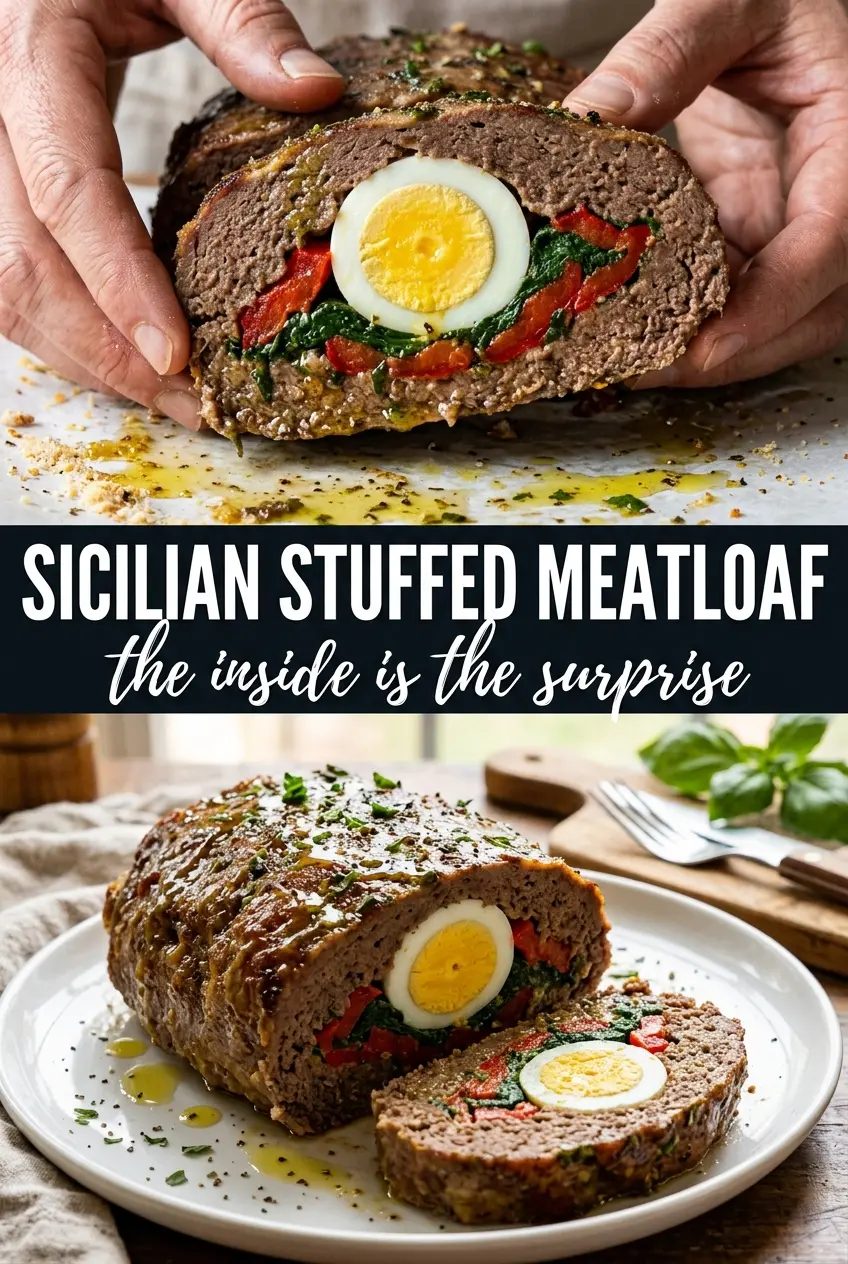
Sliced Sicilian meatloaf is the kind of dinner that stops people at the table before the first bite. The beef stays tender, the center cuts cleanly into a dramatic spiral, and every slice brings something different: salty salami, mellow provolone, greens, and that unmistakable surprise of hard-boiled egg in the middle. It eats like comfort food, but it looks like you put in far more effort than you did.
The trick is treating the meat mixture like a roll, not a mound. Once the beef is mixed just enough to hold together, it gets pressed into a rectangle so the filling can stay in a neat line and the loaf can bake evenly instead of collapsing into a rough heap. The eggs, spinach, and cured meat each earn their place: the eggs add the classic Sicilian look, the salami gives the center some salt and depth, and the spinach keeps the filling from feeling heavy.
Below, I’ll show you how to roll it tightly without tearing the meat, how to keep the filling from leaking out, and what to change if you want a slightly lighter version or need to work with what’s already in the fridge.
The spiral stayed neat and the egg centers were cooked perfectly. I was worried the loaf would fall apart when I sliced it, but resting it for 10 minutes made all the difference.
Sicilian meatloaf’s stuffed center slices cleanly when you let it rest, so the egg, salami, and spinach spiral stays gorgeous on the plate.
The Secret to Keeping the Roll Tight Instead of Patchy
The part that trips people up with rolled meatloaf is moisture management. If the filling is too wet or the meat layer is too thick in some spots and thin in others, the loaf splits as it bakes and the filling wanders out into the pan. The goal is a meat blanket that’s even enough to wrap cleanly, with just enough fat and binder to stay supple while it bakes.
Pressing the mixture onto plastic wrap helps you control the shape before it ever hits the oven. That matters here because the eggs down the center create structure, and the salami and cheese add weight. If you roll too loosely, the loaf opens on top; if you pack it too aggressively, it turns dense. A firm, even roll gives you that tidy spiral when you slice it.
- Ground beef — An 80/20 blend gives you the best balance of flavor and tenderness. Leaner beef works, but the loaf will eat drier unless you’re careful not to overbake it.
- Breadcrumbs — They bind the loaf and keep it from compacting. Fine dry breadcrumbs work best here; panko can be used, but the texture will be a little looser.
- Parmesan — This adds salt, nuttiness, and a little extra cohesion. Grate it finely so it disappears into the meat instead of leaving pockets.
- Salami or prosciutto — Salami gives a stronger, more savory punch. Prosciutto is milder and a little more elegant, but it won’t bring quite the same depth.
- Spinach — Wilt it first and squeeze out any excess water. Wet spinach is the fastest way to make the loaf leak and steam instead of roast.
- Provolone — It melts into the center and helps hold the filling together. Mozzarella can work, but it’s softer and less flavorful.
- Hard-boiled eggs — These are the signature move. They need to be peeled cleanly and cooled before rolling so they don’t tear the meat or overcook into chalky yolks.
What Each Ingredient Is Actually Doing in This Meatloaf or Meatballs
- Ground meat (the protein foundation) — Use 80/20 so it stays moist. Handle gently to keep texture tender instead of dense.
- Breadcrumbs or fillers (the binder) — These hold the meat together without making it dense. Soak in milk first so they add moisture.
- Egg (the structural binding agent) — This holds everything together during cooking. One egg per pound of meat is the right ratio.
- Onion and aromatics (the base flavor) — Mince finely so they distribute evenly. Raw onion softens as it cooks and becomes part of the texture.
- Seasonings (salt, pepper, Worcestershire, spices) — Build flavor boldly. The meat mixture carries the entire flavor profile.
- Milk or liquid (the moisture keeper) — This keeps the meatloaf tender instead of dense and dry. Don’t skip this step.
- Glaze or sauce (ketchup-based or other) — This adds sweetness, moisture, and flavor to the exterior. Apply strategically so it caramelizes.
- Resting time (the final step) — Let the meatloaf rest 10 minutes so it sets and slices cleanly. Cutting too soon makes it fall apart.
How to Roll and Bake the Loaf So the Center Stays Neat
Mixing the Meat Without Toughening It
Combine the beef, breadcrumbs, parmesan, eggs, garlic, parsley, oregano, salt, and pepper until everything is evenly distributed and no dry spots remain. Stop as soon as the mixture holds together. If you keep working it, the proteins tighten and the finished loaf turns firm instead of tender.
Building the Filling Layer
Spread the meat into a rough 10×12-inch rectangle on plastic wrap, keeping the thickness as even as you can from edge to edge. Lay the salami, spinach, and provolone over the surface, leaving a clean border around the edges so the loaf can seal. Place the hard-boiled eggs in a straight line down the center; if they’re off-center, the spiral looks lopsided and the loaf is harder to close.
Rolling It Into a Sealed Loaf
Use the plastic wrap to lift and roll the meat over the filling, tucking as you go so the seam ends up underneath. Pinch the ends closed. If the loaf tears, patch it with a little extra meat from the edge instead of trying to stretch it thin. A sealed seam is what keeps the cheese from escaping and burning in the pan.
Baking to the Right Temperature
Bake at 350°F until the center hits 160°F, which usually takes 60 to 70 minutes. The outside should be browned and the loaf should feel firm but still have a little give when pressed. If the top darkens too quickly, tent it loosely with foil. Let it rest for 10 minutes before slicing so the juices settle and the spiral stays intact.
What to Change When You Need a Different Version
Make it gluten-free
Swap the breadcrumbs for certified gluten-free breadcrumbs or crushed gluten-free crackers. The loaf will still hold together, but the texture may be a touch more delicate, so let it rest before slicing and use a sharp knife for clean cuts.
Use what you have for the filling
If you don’t have provolone, use mozzarella, fontina, or even a little shredded mozzarella mixed with parmesan. The flavor shifts a bit, but the main job is still to give the center some melt and help anchor the filling.
Go lighter on the cured meat
Use prosciutto instead of salami for a softer, less salty center. It’s a little more subtle and lets the egg and spinach stand out more, which is a good move if you want the loaf to feel a little less rich.
Make the loaf ahead
Shape the rolled loaf, wrap it tightly, and refrigerate it for up to 24 hours before baking. Chilling helps it hold its shape, but let it sit on the counter for about 20 minutes while the oven preheats so it doesn’t go into the oven icy cold and bake unevenly.
Storage and Reheating
- Refrigerator: Store slices in an airtight container for up to 4 days. The loaf firms up as it chills, which actually makes leftovers easier to slice.
- Freezer: It freezes well. Wrap individual slices tightly and freeze for up to 2 months, or freeze the whole baked loaf if you want a make-ahead dinner.
- Reheating: Reheat covered in a 325°F oven with a spoonful of marinara until warmed through. The common mistake is blasting it in the microwave, which dries the beef and makes the eggs rubbery.
Questions I Get Asked About This Recipe
Sicilian Meatloaf
Ingredients
Equipment
Method
- Preheat the oven to 350°F.
- In a bowl, mix ground beef, breadcrumbs, parmesan, eggs, garlic, parsley, oregano, salt, and pepper until combined.
- On a large sheet of plastic wrap, press the meat mixture into a 10x12 inch rectangle.
- Layer salami, wilted spinach, and provolone over the meat, leaving a 1-inch border.
- Place the whole hard-boiled eggs in a row down the center.
- Using the plastic wrap, roll the meatloaf tightly around the filling, sealing the ends, and place seam-side down in a baking dish.
- Bake 60–70 minutes, until the center reaches 160°F internally.
- Rest 10 minutes before slicing carefully.
- Serve with warmed marinara sauce.