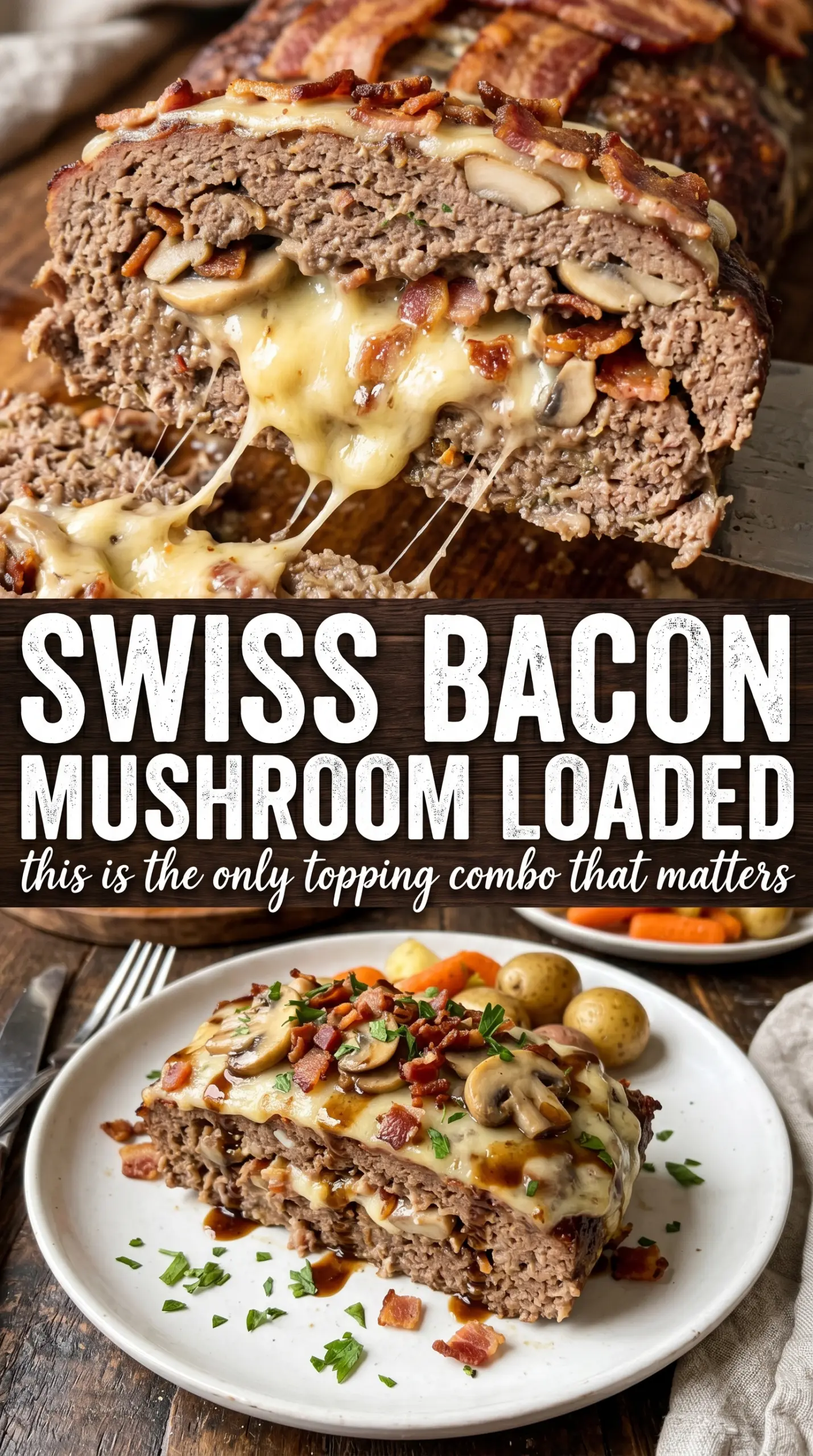
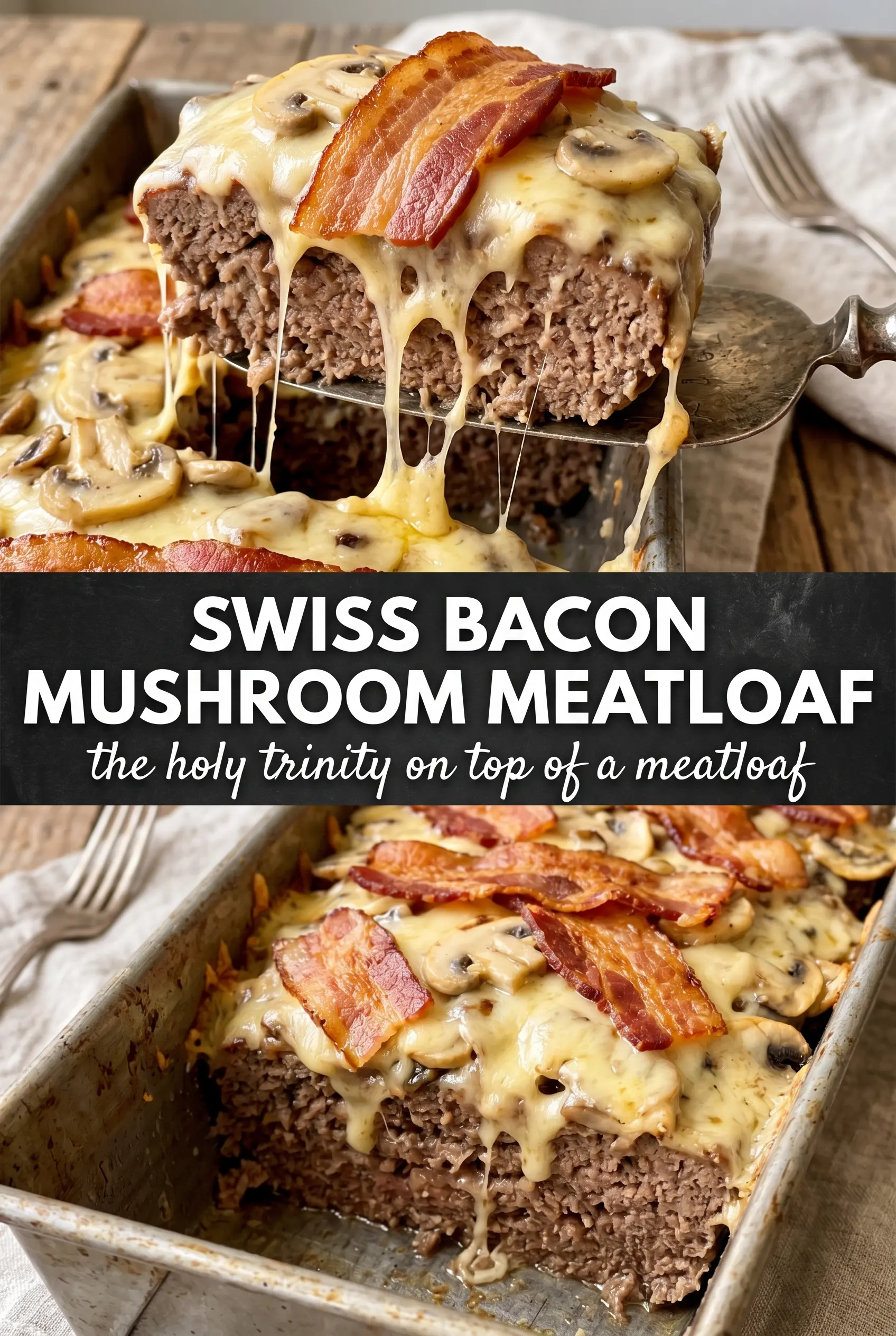
Swiss bacon mushroom meatloaf lands on the table with a deep savory slice, a caramelized glaze, and a center that stays juicy instead of drying out in the oven. The filling does more than add interest. It turns an ordinary loaf into something you cut into with a little anticipation, because the mushrooms, bacon, and melted Swiss run through every slice.
What makes this version work is the way the meat is handled before it ever goes into the pan. Grated onion disappears into the beef and keeps the texture tender, while breadcrumbs and milk give the loaf enough structure to hold the spiral without turning dense. The mushrooms need to be cooked until their moisture is gone and the bacon should be fully crisp before they go in, or the filling turns soggy and the loaf can split when you roll it.
Below, I’ve included the part that matters most when you make a stuffed meatloaf like this: how to keep the seam closed, how to tell when the center is done, and which swaps still give you that same hearty, layered finish.
The filling stayed right in the middle and the loaf sliced cleanly after resting. I was worried the Swiss would disappear, but it melted into the mushrooms and bacon in the best way.
Like this Swiss bacon mushroom meatloaf? Save it for the night you want a stuffed loaf with a juicy center and a crisp, glossy glaze.
The Trick to Keeping a Stuffed Meatloaf From Falling Apart
Most stuffed meatloaves fail for one of two reasons: the filling is too wet, or the loaf gets rolled too loosely. Wet mushrooms steam inside the meat instead of staying tucked in the center, and if the beef layer is too thin, the seam bursts open while it bakes. You want a rectangle that’s thick enough to hold together but still flexible enough to roll without cracking.
The other piece people skip is the rest after baking. Straight out of the oven, the loaf is still settling and the cheese is molten. Give it the full 10 minutes. That pause lets the juices stay in the meat instead of running across the cutting board the second you slice in.
- Ground beef — Use an 80/20 blend if you can. Leaner beef works, but the loaf won’t stay as juicy once it’s rolled and baked.
- Breadcrumbs, eggs, and milk — This is the binder system. Breadcrumbs give structure, eggs hold it together, and milk keeps the texture from turning tight.
- Grated onion — Grating instead of chopping is the difference between a loaf that feels tender and one that tastes like meat and onion pieces. The onion melts into the mixture and brings moisture with it.
- Swiss cheese — Slice it rather than shredding it. Slices create a clean filling layer and melt into a soft center instead of disappearing into the meat.
- Mushrooms and bacon — Cook both before filling the loaf. The mushrooms need to give off their moisture and the bacon needs to be crisp, or the center gets greasy and loose.
- Glaze — Ketchup and brown sugar make a sticky, tangy top that browns nicely. If you want a darker finish, brush on half before baking and the rest during the last 15 minutes.
What Each Ingredient Is Actually Doing in This Meatloaf or Meatballs
- Ground meat (the protein foundation) — Use 80/20 so it stays moist. Handle gently to keep texture tender instead of dense.
- Breadcrumbs or fillers (the binder) — These hold the meat together without making it dense. Soak in milk first so they add moisture.
- Egg (the structural binding agent) — This holds everything together during cooking. One egg per pound of meat is the right ratio.
- Onion and aromatics (the base flavor) — Mince finely so they distribute evenly. Raw onion softens as it cooks and becomes part of the texture.
- Seasonings (salt, pepper, Worcestershire, spices) — Build flavor boldly. The meat mixture carries the entire flavor profile.
- Milk or liquid (the moisture keeper) — This keeps the meatloaf tender instead of dense and dry. Don’t skip this step.
- Glaze or sauce (ketchup-based or other) — This adds sweetness, moisture, and flavor to the exterior. Apply strategically so it caramelizes.
- Resting time (the final step) — Let the meatloaf rest 10 minutes so it sets and slices cleanly. Cutting too soon makes it fall apart.
Building the Roll So the Filling Stays Put
Mix the Meat Gently
Combine the beef, breadcrumbs, eggs, milk, onion, Worcestershire, salt, and pepper just until everything looks evenly distributed. Overmixing turns the loaf springy and tight, which makes it harder to roll and less pleasant to eat. The mixture should feel cohesive but still soft enough to press out without tearing.
Shape It on Plastic Wrap
Press the meat into a 10×14-inch rectangle right on the plastic wrap. Use your hands to even out the thickness, especially at the corners, because thin edges are what split first when you start rolling. Leaving the rectangle uneven means the filling will bunch up on one side and leak out the other.
Layer the Filling in the Middle
Lay the Swiss cheese first, then the mushrooms, then the bacon, leaving a 1-inch border around the edges. That border gives you room to seal the loaf without squeezing the filling out. If your mushrooms still seem damp, cook them a little longer before assembling; any extra moisture will show up as steam pockets in the finished loaf.
Roll, Seal, and Glaze
Use the plastic wrap to help roll the meat tightly into a log, then place it seam-side down in the loaf pan. Tight rolling matters here. If the loaf is loose, it can open during baking and the cheese will escape before it has a chance to melt into the center. Spread the glaze over the top and bake until the center reaches 160°F, then let it rest before slicing so the filling stays where it belongs.
How to Adjust the Loaf Without Losing the Filling
Make It Gluten-Free
Use gluten-free breadcrumbs in the meat mixture and check that your Worcestershire is gluten-free as well. The texture stays close to the original as long as you keep the milk and egg ratio the same. Don’t skip the binder altogether, or the stuffed loaf won’t hold its shape.
Use Ground Turkey Instead of Beef
Ground turkey works, but it needs the extra moisture from the milk, onion, and cheese to avoid turning dry. Choose dark meat turkey if you can, and watch the bake time closely since lean poultry can go from done to dry fast. The flavor is lighter, but the filling still gives it plenty of depth.
Swap the Cheese
Gruyère gives a nuttier melt if you want something a little sharper than Swiss. Provolone will melt smoothly too, though it tastes milder and won’t bring the same earthy note. Use slices, not a pile of shreds, so the filling stays layered instead of disappearing into the meat.
Storage and Reheating
- Refrigerator: Store slices in an airtight container for 3 to 4 days. The glaze softens a little, but the flavor holds well.
- Freezer: This freezes well. Wrap slices tightly and freeze for up to 2 months, or wrap the whole cooled loaf before slicing if you want cleaner portions later.
- Reheating: Reheat covered in a 300°F oven with a splash of broth or water in the dish. Microwave reheating works for individual slices, but use short bursts so the cheese filling doesn’t separate and the edges don’t dry out.
Questions I Get Asked About This Recipe
Swiss Bacon Mushroom Meatloaf
Ingredients
Equipment
Method
- Preheat the oven to 350°F.
- Mix ground beef, breadcrumbs, eggs, milk, grated onion, Worcestershire, salt, and pepper until evenly combined.
- On plastic wrap, press the meat mixture into a 10x14 inch rectangle, smoothing it into an even layer.
- Layer Swiss cheese slices, sautéed cremini mushrooms, and crumbled bacon over the meat, leaving a 1-inch border uncovered.
- Roll tightly using the plastic wrap, then seal the ends to form a loaf.
- Place the rolled meat seam-side down in a loaf pan.
- Spread the glaze (ketchup and brown sugar mixture) over the top.
- Bake at 350°F for 60–70 minutes, until the internal temperature reaches 160°F.
- Rest the meatloaf for 10 minutes before slicing so the melted cheese sets.